
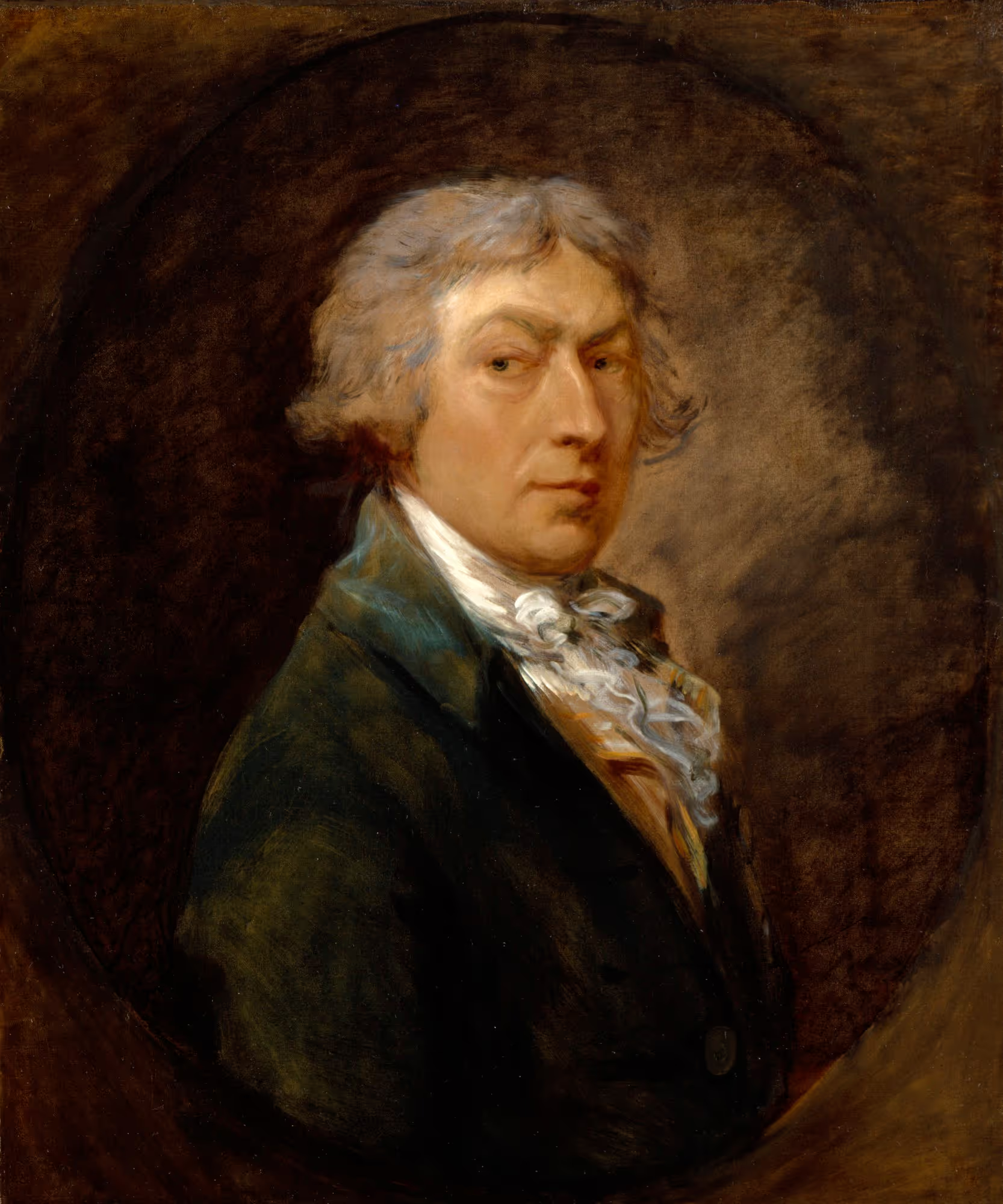
Walking into the three rooms at The Frick Collection filled with Thomas Gainsborough’s twenty-three portraits of contemporaries (plus one of Carl Friedrich Abel’s dogs) and the artist’s self-portrait provoked the immediate thought that those people from 250 years ago really put a lot of effort and money into being immortalized in oil for posterity. They’d be pleased to see the results of their vanity paying off so handsomely. However, none of this would have been possible had the artist they chose not been Thomas Gainsborough. That is, more or less, the thought that lingered in my mind while visiting Gainsborough: The Fashion of Portraiture at The Frick Collection in New York (on view till May 25, 2026)—the first exhibition of its kind in the U.S. dedicated to the 18th-century British artist.

Thomas Gainsborough – Pomeranian and Puppy, 1777 (Tate London)
Thomas Gainsborough remains, to my mind, highly underrated. Yes, he was largely confined to making a living by painting the wealthy, but he elevated that seemingly mundane occupation far beyond mere transaction. His sitters did not simply receive flattering reflections of themselves—they were etched into the art infinity. Some of his portraits are as breathtaking as da Vinci’s Mona Lisa or Vermeer’s Girl with a Pearl Earring. Just look up Woman in Blue at the Hermitage in St. Petersburg, or see again the famed The Blue Boy at The Huntington. Both inspire something close to devotion among art enthusiasts in Russia and the United States, respectively, and among art lovers everywhere else.
In particular, The Huntington portrait has left a long and well-documented trail through popular culture—there is even a book about just The Boy. Those are not in the Frick’s rooms this time, but there is plenty of blue to admire at The Frick. The fact that the color blue is present in many of the artist’s paintings is not a coincidence. Gainsborough admired Anthony van Dyck and his portraiture immensely, and Gainsborough’s satins are very reminiscent of van Dyck’s blue satins. It is worth noting that Gainsborough did not engage in the practice of hiring another artist to render the textiles of his sitters’ outfits, as it was common practice for many painters of his day. Gainsborough was the son of a textile merchant, and the love for gorgeous fashion was instilled in him—sometimes it feels like the faces complement the clothes, and not the other way around.
The use of blue was also somewhat an act of rebellion. In his Discourses on Art, Gainsborough’s rival Joshua Reynolds argued that cold colors, and especially blue, should not be the main focus of paintings. He preferred warm colors and believed that cooler ones like green, blue, and gray should support reds and yellows. Gainsborough proved, with his hundreds of paintings, that this notion was nonsense. In fact, blue became Gainsborough’s signature—practically, or as we would say now, his brand identity. There is a celebrated myth that Gainsborough painted The Blue Boy specifically to make a fool out of Reynolds and his color theories.
The word “fashion” in the exhibition’s title requires a bit of context. As noted in The Frick Collection’s introductory materials: “According to Samuel Johnson’s Dictionary (1755), the word fashion connoted a rank below nobility but above the ‘vulgar.’ For ‘people of fashion,’ what one wore in a portrait mattered as much as who painted it and how. The form, mood, and maker of a portrait could go in and out of style just as clothing did. One of the most fashionable painters of his day, Gainsborough also explored the power of portraiture to subvert the rigid rules of British social class.” The appetite for being depicted in the latest fashion—despite the Royal Academy’s discouragement of such trends—worked very much in his favor. So did his long residence in Bath, a spa town in southwest England famed for its mineral-rich hot springs, where the British aristocracy gathered in hopes of curing their gout—and, in the process, made themselves readily available for portrait commissions. If, years later, they felt the fashions in their portraits were unbearable to look at, they could bring them in for updates—Gainsborough would paint over them, as in Mrs. Sheridan’s portrait, making her dress less trendy and more abstract the second time.

Thomas Gainsborough – Mrs. Richard Brinsley Sheridan, 1785-1787 (Washington, D.C.)
Another documented example involves Mrs. Samuel Moody’s portrait, initially painted in 1779. Sometime after her death, Gainsborough was obliged to add her two sons to her portrait in 1784. Portraiture before photography was not always treated with the reverence we accord it now. Gainsborough painted very quickly, and that speed may have had something to do with how much he came to dislike painting portraits—and the commissioners especially. He is widely considered one of the finest interpreters of English landscapes—he admitted as much: “I paint portraits to live, and landscapes because I love them.” Sometimes there are amusing details, like Mrs. Sheridan’s hair, which looks strikingly like the canopy of the tree she sits under.
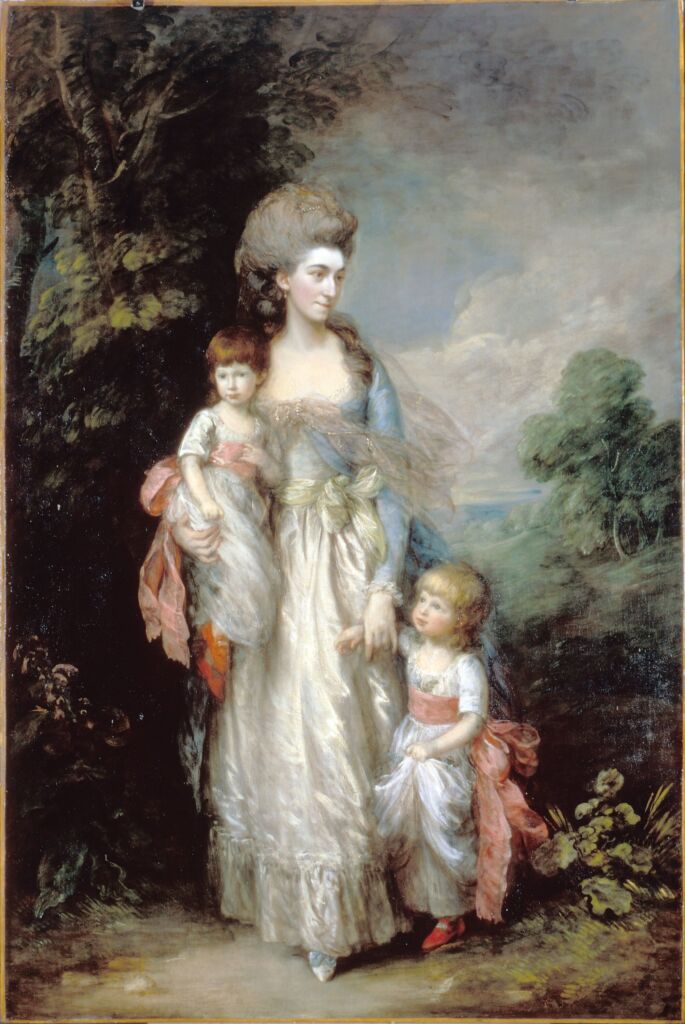
Thomas Gainsborough – Mrs. Elizabeth Moody with her sons Samuel and Thomas, 1779 (Dulwich Picture Gallery)
The most spectacular marriage of portraiture, fashion, and landscape is evident in the portrait of Mr. and Mrs. Andrews at this exhibition. Painted by Gainsborough at the age of 23, probably at his most rebellious, he rendered the newlyweds in a borderline cartoonish way. We look at them and are met with expressions of arrogance and disdain. Mrs. Andrews is in her teens, but in the most egregiously fabulous dress—not usually worn in casual countryside settings—and looks like a jaded middle-aged woman, bored with her lack of problems because she has everything, including the property beside her, ready to be admired and envied. Her husband, with the same aloof, blank stare, stands next to her with a rifle, ready to shoot some pheasants—or perhaps having just done so. We will not know for sure, because the portrait is not finished—there is a blank spot beneath Mrs. Andrews’ hands in the middle of her enormous gown. The commission was never completed, perhaps because the pair realized that the artist did not like them much. Painted around 1750, it remained publicly unseen for 177 years, until an exhibition in Ipswich in 1927, having stayed in the Andrews family’s possession. The National Gallery in London purchased it in 1960. You can and should learn more about it in this amazing exploration by James Payne.

Thomas Gainsborough – Mr. and Mrs. Andrews, 1750 (National Gallery, London)
One of my favorite life stories in the exhibition is that of Grace Dalrymple Elliott, depicted in two portraits—one in the Frick’s permanent collection, and another on loan from the Metropolitan Museum of Art. Her smaller portrait from 1782 is my favorite. She looks straight at us with her eyelids half closed, with an expression of utter gentleness and vulnerability. Her clothes, painted with light strokes, emphasize her sensuality. The beauty mark and the black ribbon with the jewel look more pronounced on her white alabaster skin, oozing with eroticism. Ms. Elliott was tall and beautiful, and only seventeen when she married Dr. Elliot. She had scandalous affairs with prominent men, and that led to the divorce. Her social status was compromised, and she eventually moved to France, where, at the height of the French Revolution, she was imprisoned, avoided the guillotine numerous times, and wrote the memoir Journal of My Life During the French Revolution, which Eric Rohmer based his 2001 film L’Anglaise et le Duc on. Could one suspect any of this complicated life story just by looking at this portrait?

Thomas Gainsborough – Mrs. Grace Dalrymple Elliott, circa 1778 (The Frick Collection, New York)


